



How a Test Patch Helped Save a 30-Year-Old Clay Tile Roof
Roof Cleaning In St Helens.
Sometimes the most important decision we make on a roof-cleaning job is knowing when not to start cleaning straight away.
This recent roof cleaning project in St Helens involved a large detached property, approximately 30 years old and valued at around £800,000.
The roof was covered with traditional clay Rosemary tiles, and the customer contacted us because he was concerned about their condition. In fact, he’d reached the point where he thought he might need an entirely new roof.
When we arrived and inspected it properly, I could understand why.
There was significant moss and organic growth across the roof, but that wasn’t my biggest concern.
Some of the clay tiles themselves were already showing signs of deterioration.
Rather than simply starting the clean and hoping for the best, we stopped, spoke to the customer and changed the plan completely.
What followed was a test patch, a gentler cleaning process, a full roof clean, biocide treatment and some relatively minor repairs.
The result exceeded the customer’s expectations – and, based on my estimate, potentially avoided a replacement roof costing somewhere in the region of £30,000.
The Customer Thought He Might Need a New Roof
The starting point for this project was unusual.
The customer wasn’t simply asking us to make a dirty roof look better.
He was genuinely concerned that the existing roof might have reached the end of its useful life.
At around 30 years old, the roof had accumulated considerable moss and organic growth. From a distance, that made it difficult to distinguish between a roof that was simply heavily contaminated and one where the tiles themselves were failing.
That distinction matters.
Roof cleaning can transform a suitable existing roof.
It cannot repair fundamentally defective tiles or magically turn an unsuitable roof into a sound one.
That’s why the first proper inspection was so important.
Roof Cleaning In St Helens. We Arrived at 7:45am – But I Didn’t Let the Team Start Cleaning
We arrived at approximately 7:45am, with the driveway cleared and everything ready for us to set up.
But before the cleaning began, I personally went up to assess the roof.
That’s when I spotted the problem.
The Rosemary tiles were more fragile and crumbly in places than I was comfortable with.
The close-up photographs from the job show exactly what concerned me.
On some individual tiles, the exposed surface was already flaking and deteriorating. There was also moss established between and around the tiles.
At that point, simply carrying on with our normal process wasn’t an option for me.
Why Moss Was a Concern on These Rosemary Tiles
There was a lot of moss sitting between the tiles.
One concern with established moss is the moisture it can retain. During freezing conditions, moisture held around roof coverings can freeze and expand.
On a roof where some clay tiles are already deteriorating, that’s something we have to take seriously.
But there was another issue.
Once you’ve got heavy organic material covering parts of an older roof, you don’t necessarily know exactly what condition every surface underneath it is in until you start removing that contamination.
So I spoke to the customer.
I Told the Customer There Was a Risk
I explained exactly what I’d found.
I couldn’t promise him that every tile would respond perfectly to cleaning.
There was a possibility that removing the moss and contamination could expose deterioration that was already present.
And with some of the tiles already showing signs of surface breakdown, I wanted the customer to understand that before we proceeded.
I would much rather have that conversation before touching the roof than clean the whole thing and explain a problem afterwards.
The customer asked what I recommended.
My answer was simple:
Let’s test it first.
Carrying Out a Test Patch Before Committing to the Whole Roof
We selected a small area and carried out a test patch.
This gave us an opportunity to see how the existing clay Rosemary tiles responded before committing to the entire roof.
I took photographs and video of the test area so the customer could see the result as well.
The test came out well.
Crucially, we weren’t seeing the kind of further deterioration I’d been concerned about.
The customer was happy with what he saw and gave us the go-ahead to continue.
That test patch changed the direction of the entire project.
We Changed Our Cleaning Process for This Roof
Even with a successful test, I wasn’t prepared to treat this like an ordinary roof.
We changed the cleaning process to suit the condition of the tiles.
The roof received a full pre-softwash treatment first.
The idea was to treat the moss and biological growth beforehand so that the subsequent cleaning could be carried out more delicately.
This is where experience matters.
Professional roof cleaning shouldn’t mean using exactly the same process on every property.
The correct approach depends on what you’re actually dealing with.
A relatively modern concrete tiled roof and a 30-year-old clay Rosemary roof showing some surface deterioration shouldn’t automatically be treated identically.
On this property, adapting the process produced the result we wanted.
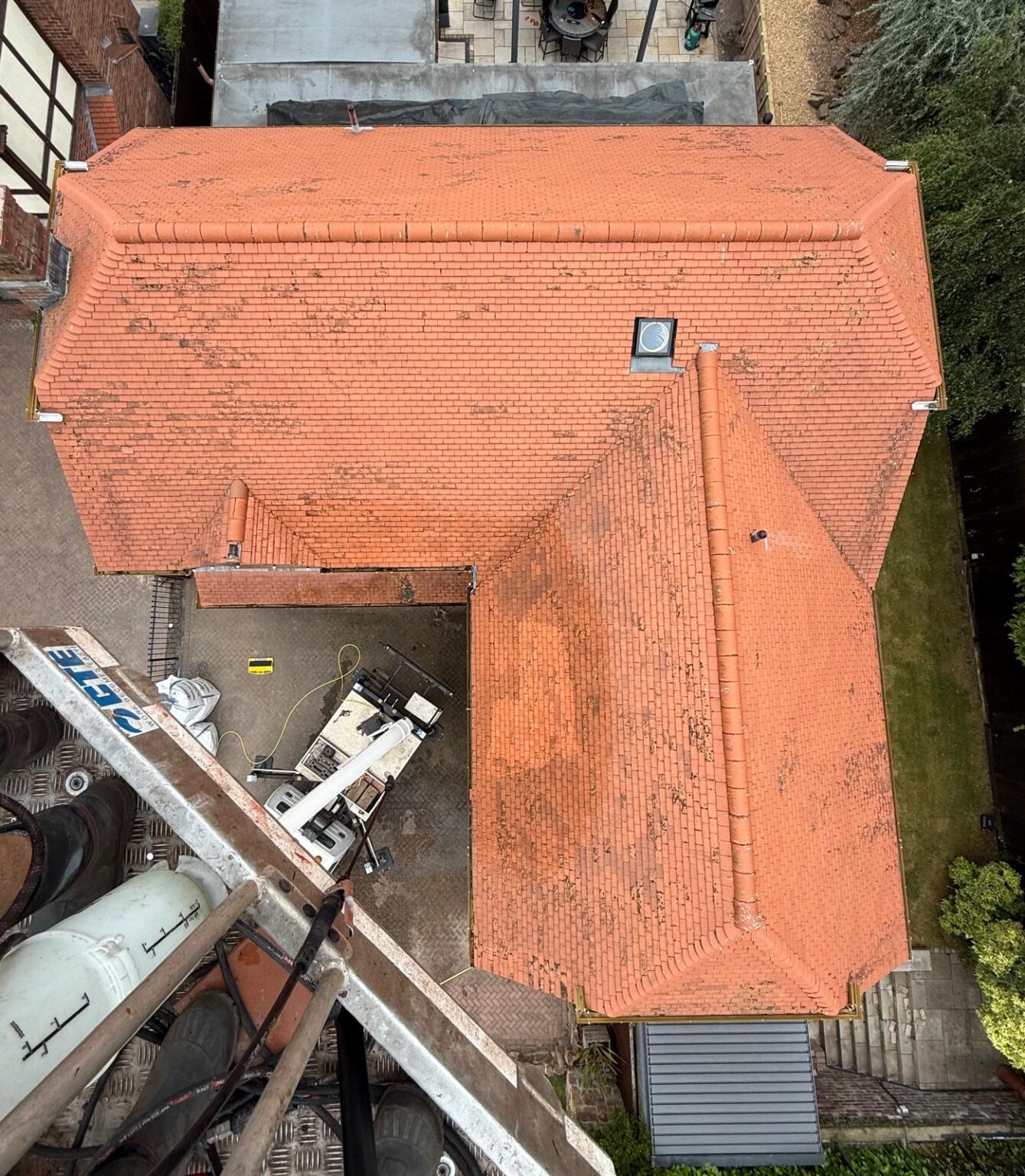
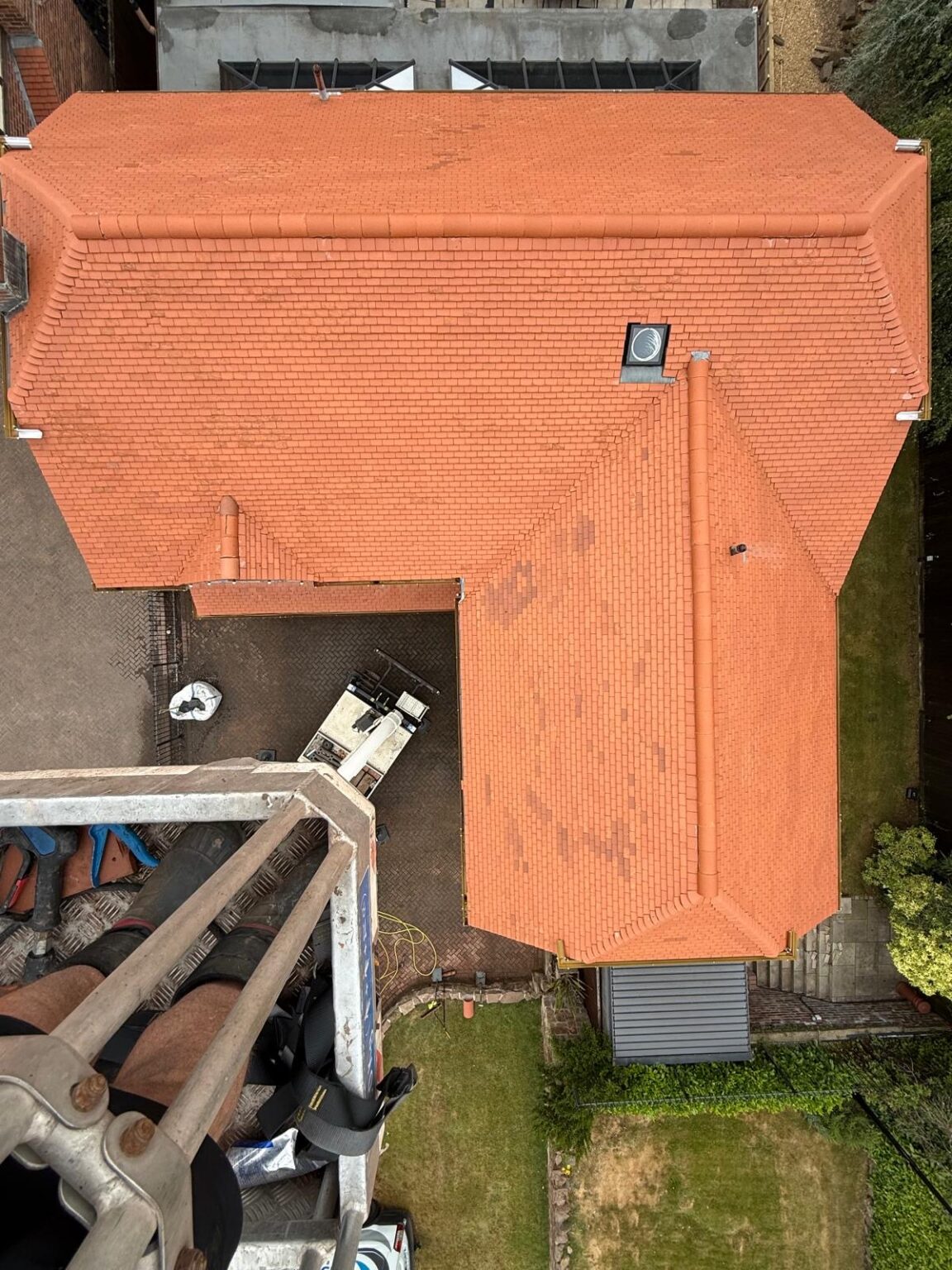
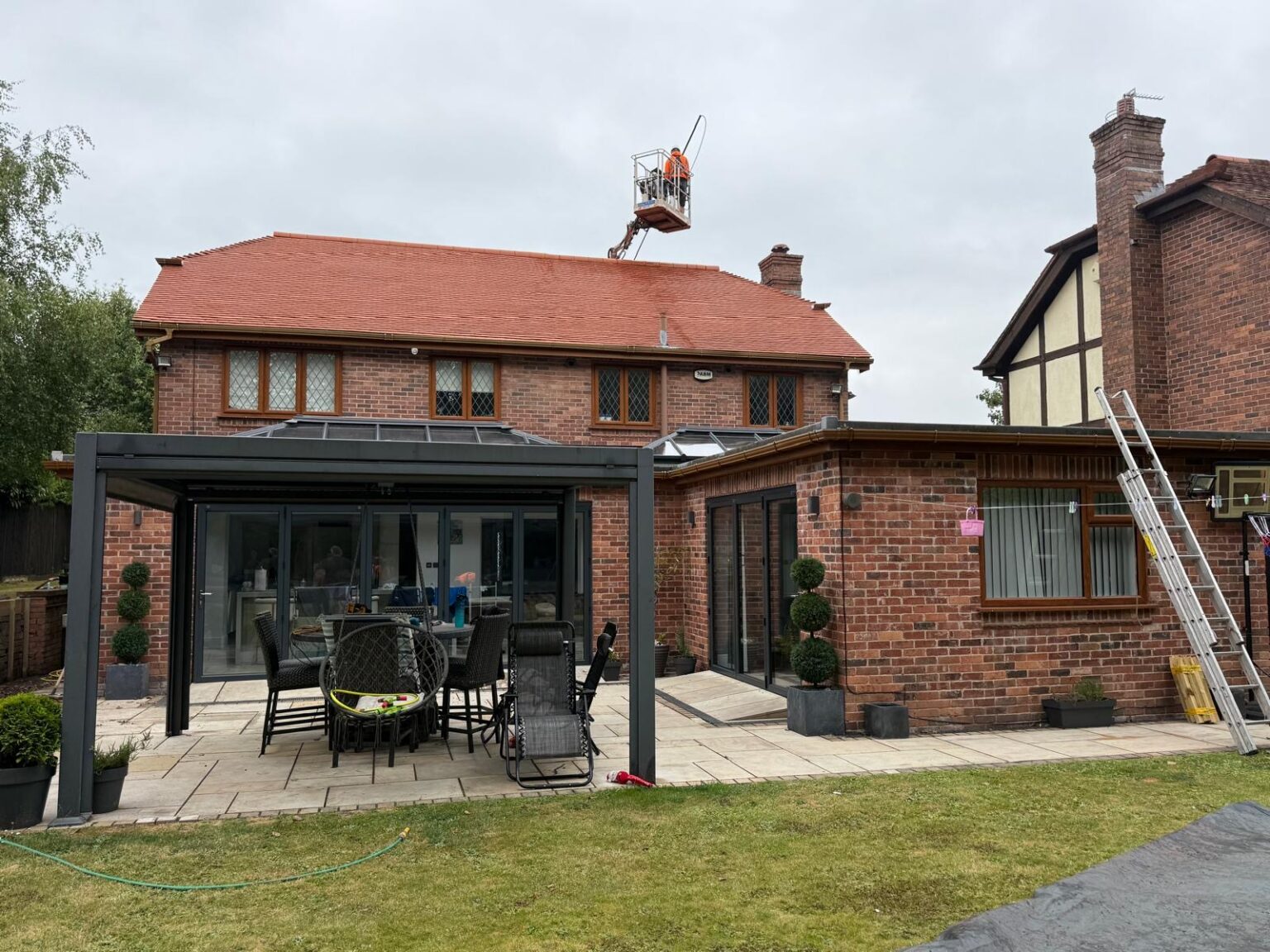
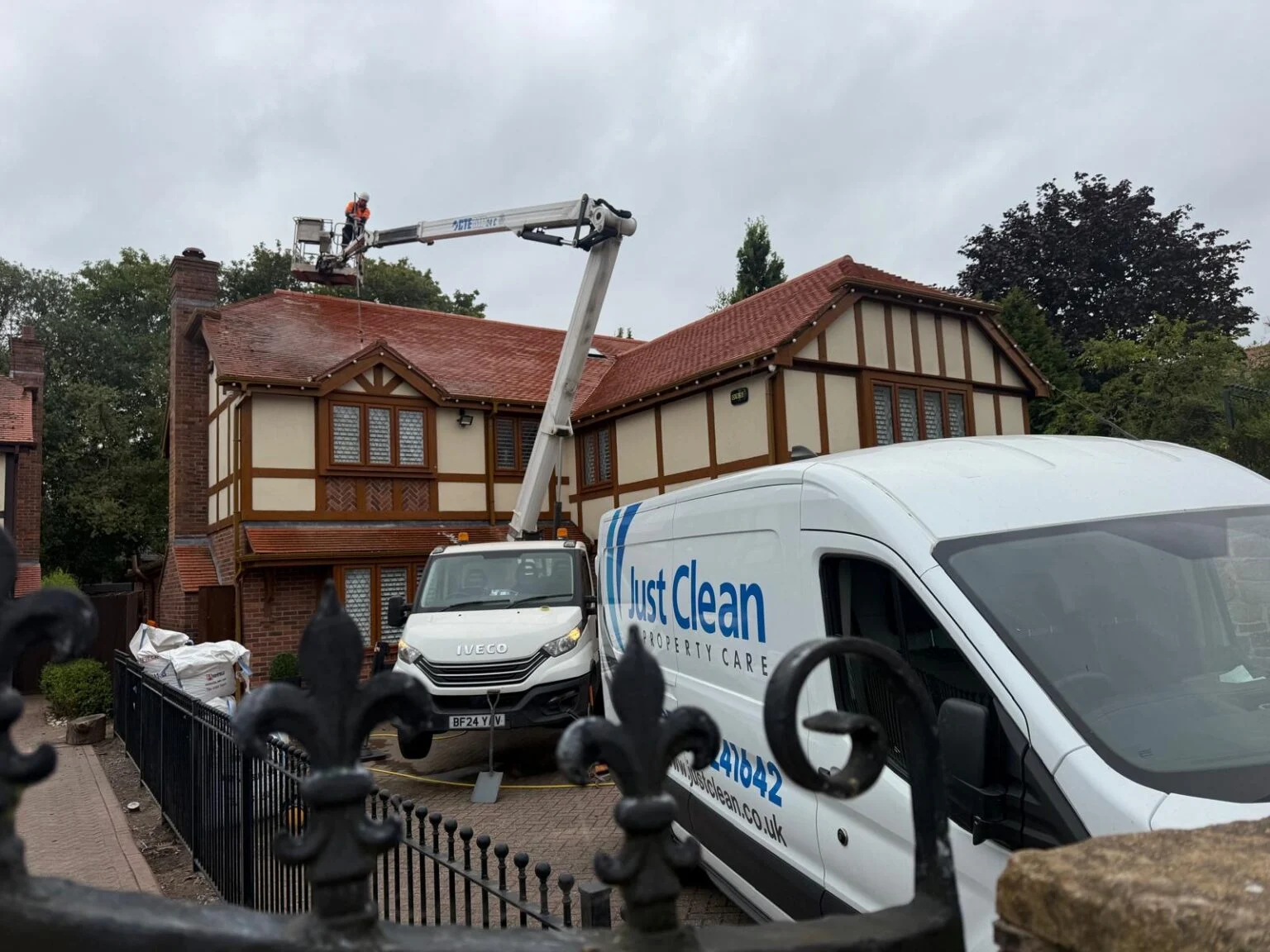
Working From the Cherry Picker
The photographs from the project show the team working from our powered access equipment.
Using the cherry picker allowed the technician to work from the basket at roof level and progressively cover the different elevations.
This was particularly useful because the property has a sizeable and fairly complex roof.
From above, you can see several intersecting sections, valleys, hips and different roof elevations.
There is also a rooflight and various junctions that need to be worked around carefully.
Access is part of the job.
The aim isn’t simply to reach the roof somehow. It’s to put the technician in an appropriate working position for the section being treated.
The Original Colour Started Coming Back
Once the cleaning progressed, the transformation became obvious.
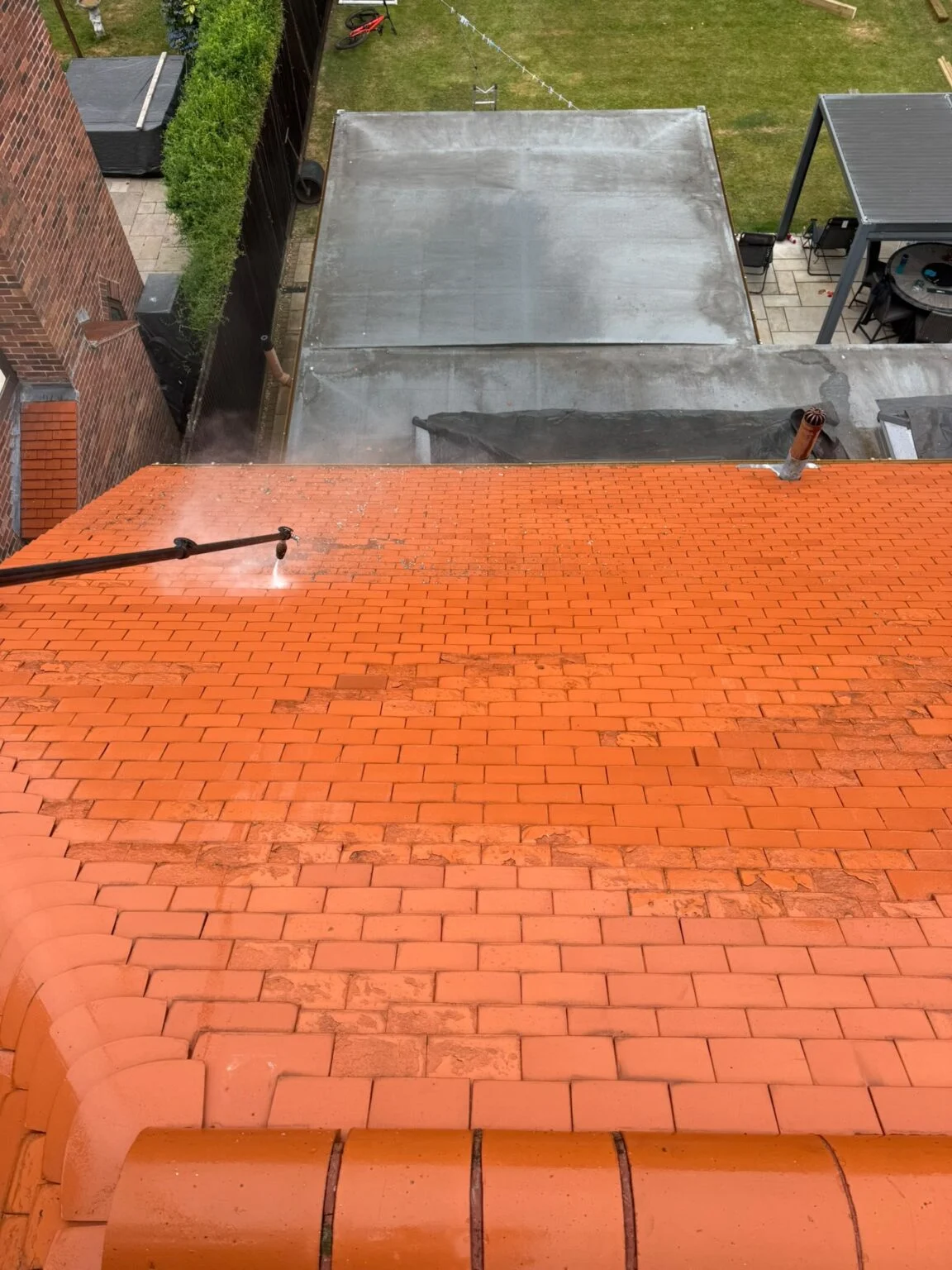
The roof had become weathered and contaminated over many years, hiding much of the distinctive warm orange/red appearance of the clay tiles.
As the biological growth was treated and removed, that colour started returning.
The aerial images are particularly impressive.
Looking directly down on the property, you can see how extensive the tiled roof actually is and how many different sections needed to be cleaned.
The finished roof has a much brighter and more consistent appearance while still retaining the natural character of the existing clay tiles.
It is important to remember:
These weren’t new tiles.
They were the customer’s existing roof tiles.
The Close-Up Photograph Tells an Important Part of the Story
One of the photographs I’d definitely include prominently in this case study is the close-up of the tile surfaces.
It’s not the prettiest image from the project – but it’s arguably the most important.
You can physically see areas where the faces of some clay tiles had already started deteriorating.
That photograph explains why I didn’t simply tell the lads to start cleaning.
It shows the condition we were assessing.
And it demonstrates why carrying out the test patch was sensible.
A good case study shouldn’t only show the glamorous finished photograph.
It should show what we actually had to deal with.
Post-Treatment With Biocide
After the full clean was completed, we applied a post-treatment biocide.
This forms part of the longer-term treatment of biological growth.
The aim is not simply to make the roof look clean on the day we leave.
The post-treatment helps deal with remaining biological contamination and helps inhibit future moss and organic growth.
On a roof that had already experienced substantial moss build-up, that was particularly relevant.
Two Ridge Tiles Replaced and Repointing Completed
Cleaning wasn’t the only work required.
During the project, we also needed to replace two ridge tiles and carry out repointing to part of the roof.
Again, this is why inspecting a roof properly matters.
The objective wasn’t simply to produce attractive before-and-after photographs.
Where relatively minor repairs were required, they could be dealt with as part of getting the roof back into better overall condition.
The roof cleaning, softwashing and repairs were all completed within one day.
Potentially Avoiding a £30,000 Replacement Roof
This is where the project became particularly satisfying.
At the beginning, the customer believed he might need a completely new roof.
After assessing it, testing the cleaning process, adapting our method and carrying out the necessary minor repairs, the existing roof remained in place.
Based on my experience and the size and nature of this property, I estimated that replacing a roof of this scale could potentially have cost the customer around £30,000.
That’s an estimate rather than a roofing quotation, and replacement costs obviously vary.
But the important point is that the customer didn’t need to jump straight into replacing the entire roof.
We established what could safely be achieved with the existing tiles first.
For me, that’s the real success of this project.
The Customer Said We Exceeded His Expectations
The customer was made up with the finished result.
He told us that Just Clean had exceeded his expectations.
Considering where the conversation had started – with him thinking he might need an entirely new roof – that’s a particularly satisfying outcome.
We didn’t promise him something before inspecting it.
We didn’t ignore the deterioration.
And we didn’t just clean the entire roof and hope nothing went wrong.
We stopped.
We explained the risk.
We tested an area.
We changed our process.
And only when both we and the customer were satisfied did we continue with the complete roof.
Why This St Helens Roof Cleaning Project Matters
For me, this case study demonstrates something important about professional roof cleaning.
Knowing how to clean a roof matters. Knowing when to change your approach matters just as much.
Every roof is different.
Age matters.
Tile type matters.
Existing deterioration matters.
Access matters.
And sometimes the right answer is to test a small area before deciding whether the entire project should proceed.
In this case, that decision helped us take a customer from believing he potentially needed a new roof to looking at his existing 30-year-old Rosemary tiled roof completely transformed.
That’s a result I’m very happy with.
Project at a Glance
Location: St Helens
Property: Large detached home
Approximate property age: 30 years
Approximate property value: £800,000
Roof covering: Clay Rosemary tiles
Customer’s initial concern: Believed the roof might need replacing
Initial inspection: Some tiles showing existing surface deterioration/flaking
Additional issue: Significant moss growth between tiles
Decision: Cleaning paused while Clint discussed the condition with the customer
Test: Small test patch completed and documented with photographs/video
Result of test: Successful, allowing the customer to approve the full clean
Cleaning approach: Adapted process with full pre-softwash treatment before delicate cleaning
Access: Cherry picker
Post-treatment: Biocide
Repairs: Two ridge tiles replaced and part of the roof repointed
Duration: Roof cleaning, softwashing and repairs completed in one day
Potential replacement cost: Clint estimated approximately £30,000 for a roof of this scale
Customer response: Extremely pleased; said Just Clean exceeded expectations
Frequently Asked Questions
Can you clean old clay Rosemary roof tiles?
Potentially, but the condition of the individual roof should be assessed first. On this 30-year-old St Helens roof, some Rosemary tiles were already showing surface deterioration. Just Clean therefore carried out a test patch and adapted the cleaning process before proceeding with the complete roof.
Why would you carry out a roof cleaning test patch?
A test patch can help establish how an older or potentially fragile roof surface responds before cleaning the entire property. On this project, the test allowed both Just Clean and the homeowner to assess the result before deciding to continue.
Can moss damage or contribute to deterioration of roof tiles?
Moss can retain moisture around roof coverings. During cold conditions that moisture can freeze and expand, which can be an additional concern where tiles are already ageing or deteriorating. The condition of the roof should therefore be assessed rather than assuming moss is purely cosmetic.
Is roof cleaning cheaper than replacing a roof?
They are completely different services, and a roof that genuinely requires replacement should not simply be cleaned instead. On this project, however, the customer initially believed he might require a new roof. After assessment, a successful test clean and minor repairs, the existing roof could be retained. Clint estimated that replacement of a roof of this scale might have cost around £30,000, although actual replacement costs vary considerably.
Discuss your roof cleaning project
Send your postcode and photographs so we can assess the roof, its condition and access.
Explore roof cleaning and moss removal · Request a quote · More case studies