


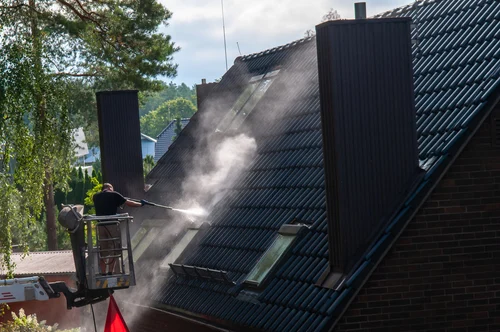
Roof cleaning methods should be chosen for the roof covering, its condition and the manufacturer’s care guidance. Manual moss removal, softwashing and controlled low-pressure cleaning have different uses and limitations. A method that works on one property may be unsuitable for another.
Start with the roof’s condition
Before choosing equipment, check the covering, age, visible damage, existing leaks and access. Loose tiles, deteriorating surfaces and failed pointing need assessment. Cleaning removes contamination; it does not repair defects or make an unsound roof serviceable.
A homeowner can provide photographs taken from a safe position on the ground. Close inspection and work at height should be planned by a competent professional using suitable access equipment.
Manual moss removal
Careful manual removal can be considered where the roof covering and its condition allow it. The tools and access must suit the tiles or slates. Aggressive scraping or unsuitable tools can damage an existing surface, so manual cleaning is not automatically the gentlest option for every roof.
Ask how loosened moss will be collected and whether gutters and downpipes are included in the work.
Softwashing and treatment
Softwashing uses a suitable treatment to address biological growth. Products, concentration, application and contact time must follow the product label and be compatible with the roof covering. Runoff, nearby plants, people and animals must be considered.
Treatment does not repair broken tiles or create a waterproof coating. Ask whether the work includes physical removal, treatment, rinsing or a later visit, because “softwashing” can describe different service packages.
Pressure washing and controlled low-pressure methods
High-pressure washing is not a routine recommendation for every roof. It can damage coverings and force water into unsuitable places. Manufacturer guidance should take priority. Marley’s moss-removal guidance cautions against pressure washing and explains that the appropriate approach depends on the covering and its condition.
Where a professional proposes controlled low-pressure cleaning, including steam where appropriate, ask why it is suitable for this particular roof and how the existing surface, access and drainage will be protected. A pressure setting alone does not establish suitability.
What should a quotation explain?
- The roof areas, covering and condition being assessed.
- The proposed cleaning method and any limitations.
- The access equipment and arrangements for the surrounding property.
- Whether gutter clearance, treatment or repairs are included.
- How debris and runoff will be managed.
There is no universal moss-free period. Shade, moisture, nearby trees and the roof’s surroundings affect regrowth. Discuss aftercare without assuming a fixed guarantee.
Read Marley’s guidance on roof moss and cleaning methods. For an assessment of your property, see our roof cleaning and moss removal service.
Questions to ask before booking
Ask why the proposed method suits the covering, how access will be arranged, how debris and runoff will be handled, and what is included in the price. Confirm whether treatment, gutter clearance or repairs are separate. Do not choose solely by a method name or an advertised pressure setting.